

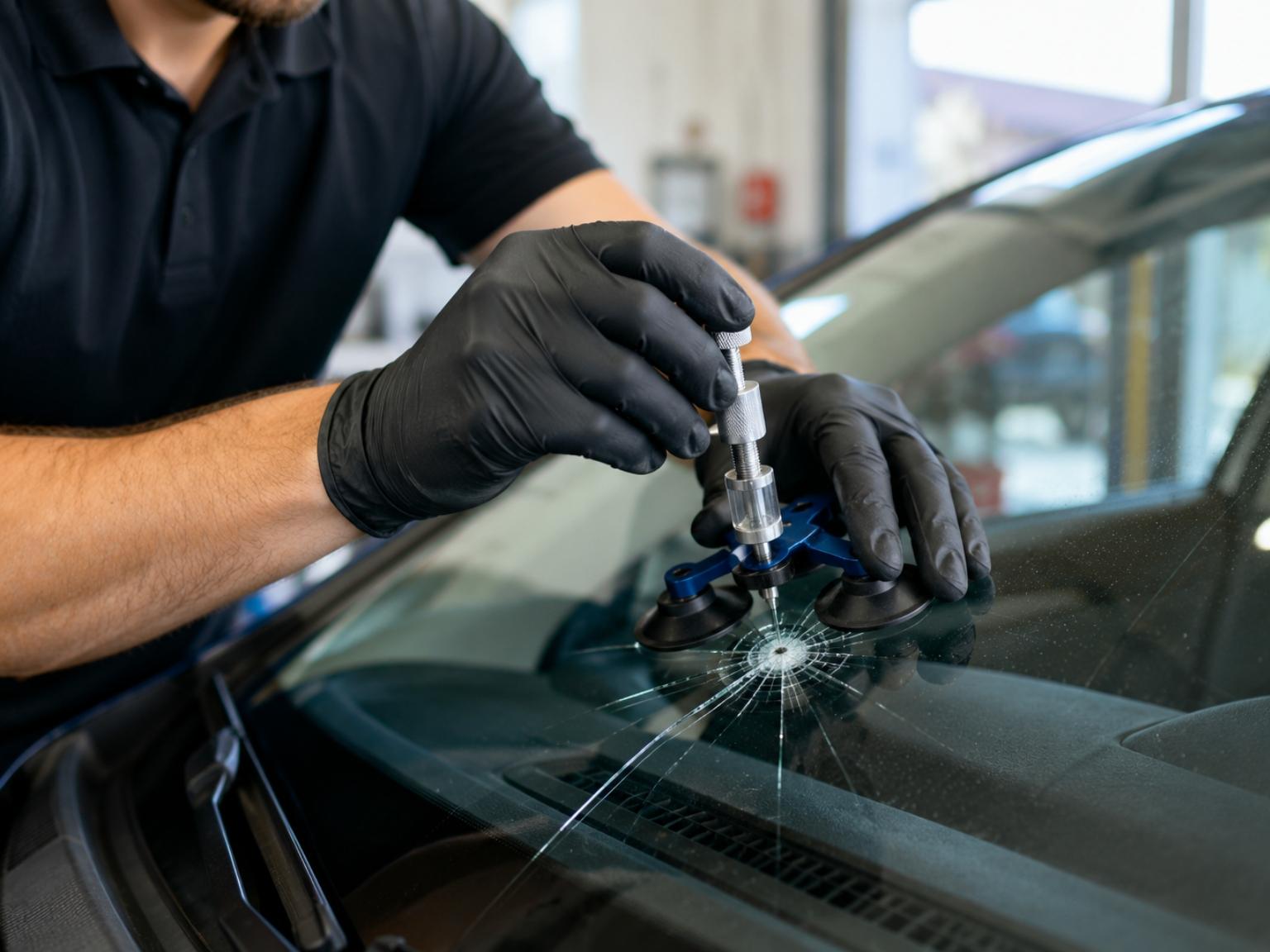
Many drivers assume that once car glass is cracked, replacement is the only option. In reality, modern repair techniques can restore many types of windshield damage safely and effectively. Whether car glass repair is possible depends on several factors, including the size, location, and condition of the damage, making a professional inspection the most important first step.
Can Broken Car Glass Be Repaired?
Yes, but not always.
Professional car glass repair works by injecting a specialized resin into damaged laminated glass, restoring its strength and preventing the damage from spreading. While many small chips and cracks can be repaired, some types of damage require a complete replacement to ensure the vehicle remains safe to drive.
Before recommending a repair, technicians evaluate several factors that determine whether the glass can be effectively restored or replaced.
Factor #1: The Size of the Damage
Size is one of the first things a technician measures when deciding whether car glass repair is possible. As a general guideline, chips up to about 1 inch (25 mm) in diameter and cracks up to about 3–6 inches (75–150 mm) long are often repairable if no other complicating factors are present.
Larger cracks are more likely to continue spreading, even after repair, and may not restore the windshield’s original strength. If the damage exceeds the repair limits recommended by the repair manufacturer or extends across a significant portion of the windshield, replacement is usually the safer choice.
Factor #2: The Location of the Damage
Even a small chip may require replacement if it’s in the wrong location. Damage located directly in the driver’s primary field of vision is often not repaired because the resin can leave slight optical distortion, which may affect visibility.
Cracks that are within about 2 inches (50 mm) of the windshield’s edge are also less likely to be repairable because they can weaken the structural bond between the glass and the vehicle frame.
For side and rear windows, location matters less than the type of glass. Since these windows are usually made of tempered glass, even small breaks generally require replacement.
Factor #3: The Type of Glass That Is Damaged
Whether the damaged glass can be repaired depends largely on how it was manufactured.
The windshield is made from laminated glass, consisting of two sheets of glass bonded together with a durable plastic (PVB) interlayer. This layered construction allows repair resin to fill chips and small cracks while helping maintain the glass’s structural integrity.
Most side and rear windows are made from tempered glass, which is heat-treated to shatter into small, blunt pieces during impact. Once tempered glass breaks, even from a small chip, it cannot be repaired and must be replaced.
Factor #4: The Type of Crack or Chip
Simple damage, such as bull’s-eye chips, half-moon chips, and small star breaks, is often repairable because the resin can completely penetrate the damaged area. However, combination breaks, edge cracks, long stress cracks, and damage with multiple impact points are more difficult to repair successfully.
Technicians also examine whether the crack has “legs” branching in multiple directions or whether separate chips have merged into one larger fracture, as these conditions reduce the likelihood of a durable repair.
Factor #5: How Long You’ve Waited
A repairable chip can become non-repairable surprisingly quickly. When damage is left exposed for days or weeks, dust, road salt, moisture, and cleaning chemicals can enter the break. These contaminants prevent the repair resin from bonding properly, reducing both the appearance and strength of the repair.
Temperature changes also play a major role. Running the defroster on a cold morning or parking in direct summer sunlight causes the glass to expand and contract, increasing the chance that a small chip will spread into a longer crack.
Factor #6: The Depth of the Damage
Technicians don’t just measure the length of a crack. They also determine how deep it extends.
A typical laminated windshield has two layers of glass separated by a plastic interlayer. If the damage affects only the outer layer, repair is often possible. However, if the crack penetrates the plastic interlayer or reaches the inner layer of glass, the windshield’s structural performance may already be compromised.
In these cases, replacement is generally recommended because resin cannot fully restore damage that extends through multiple layers.
Factor #7: Your Vehicle’s Safety Technology
Many newer vehicles have cameras and sensors mounted behind the windshield that support Advanced Driver Assistance Systems (ADAS), including lane-keeping assistance, adaptive cruise control, traffic sign recognition, and automatic emergency braking.
If a crack extends into the area where these cameras are mounted, which is typically behind the rearview mirror near the top center of the windshield, repair may not be recommended. Replacing the windshield and recalibrating the ADAS cameras helps ensure these safety systems continue to function accurately.
Protect Your Safety by Acting Early
A cracked windshield doesn’t always mean you need new glass. The size, location, depth, type of damage, type of glass, timing, and your vehicle’s safety technology all determine whether car glass repair is possible. Addressing the problem early gives technicians the best chance to repair the damage before it spreads, saving you time and money.
If you notice a chip or crack, have it professionally inspected as soon as possible so you can choose the safest and most cost-effective solution for your vehicle. AMB Auto Glass and Window Tint provides professional auto glass inspections and repairs to help restore your vehicle’s safety and visibility before minor damage becomes a more expensive problem.